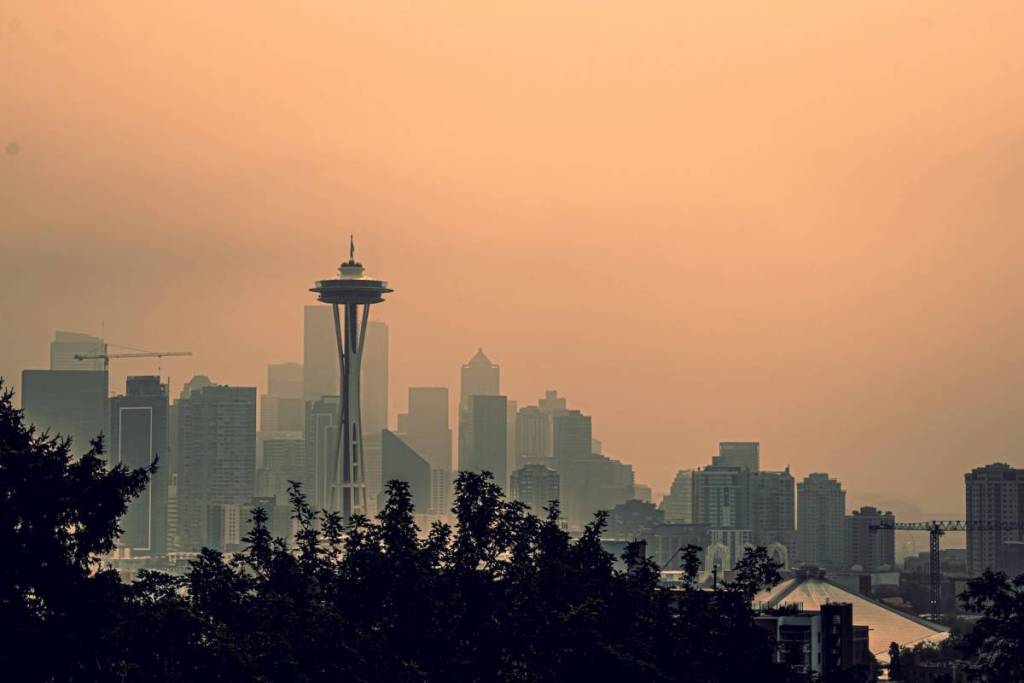

As multiple wildfires continue to rage across Eastern Washington, officials are urging Seattle-area residents to prepare for the possibility of smoky skies and summer heat this week.
Over the weekend, three fast-growing wildfires on the outskirts of Spokane forced tens of thousands of residents to evacuate, while hundreds of homes and other structures were destroyed. Additional large fires are also burning near the Colville Reservation and the Lake Chelan area.
Although Western Washington has so far been spared the worst of the smoke, forecasters say shifting wind patterns beginning Tuesday could carry wildfire smoke into the Puget Sound region. While the exact timing and intensity remain uncertain, air quality may deteriorate to unhealthy levels, with reduced visibility possible through Thursday.
The smoky conditions are expected to coincide with a stretch of hot weather in Seattle. High temperatures are forecast to reach about 85 degrees on Tuesday before climbing to around 90 degrees on Wednesday and Thursday.
Why is it important to protect yourself from wildfire smoke? Wildfire smoke contains fine particles that can inflame the lungs and aggravate breathing problems. Children, older adults, pregnant people, and anyone who spends extended time working or exercising outdoors face a greater risk of health impacts.
Here’s how to prepare for this week’s hot weather and wildfire smoke in Seattle:
Stock up on essentials now
To avoid unnecessary trips outside, you may want to stock up on groceries and other essentials on Monday.
Stay inside with air purifiers running and windows closed
Health officials recommend limiting time outdoors if smoke becomes noticeable and keeping windows and doors closed whenever possible. Running an air purifier can help improve indoor air quality. Those without one can DIY a low-cost filtration system by attaching a MERV 13 or FPR 10 furnace filter to a box fan with masking tape. Studies suggest this setup can reduce certain airborne particles by as much as 90%, but it should never be left unattended, operated while sleeping, or run continuously without periodic cooling breaks.
If your home doesn’t have air conditioning and becomes overheated with the windows shut, here are some steps you can take to stay cool:
- Put a bowl of ice under a fan.
- Cover the windows with blankets (particularly the silver type of emergency survival blanket that reflects heat).
- Keep your electronics, lights, and oven off.
- Take a cool shower, drink cool liquids and electrolytes, and wear a wet shirt or bandana.
- Stay on the lowest floor.
Take refuge in air conditioned public places
Many homes in Seattle still do not have air conditioning, even though rental laws in WA are attempting to change that. For those without air conditioning, libraries, museums, shopping malls, senior centers, and other public buildings often provide cooler, filtered indoor spaces. You can find a list of cooling centers near you here.
Wear a mask when outside
If going outdoors is unavoidable, wear a properly fitted N95 or P100 respirator. These can be found at hardware stores. Surgical masks, paper masks, and cloth face coverings do not provide adequate protection against wildfire smoke.