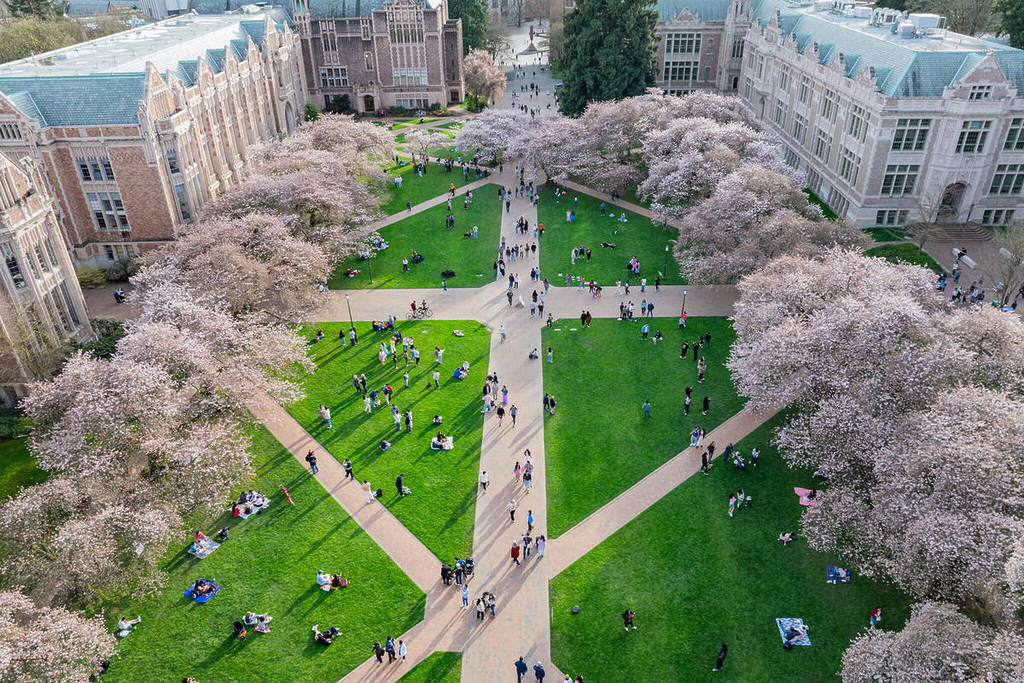

Every spring, thousands of people head to the University of Washington Quad to see one of Seattle’s most beloved seasonal sights: rows of fluffy pink cherry trees bursting into bloom. As temperatures begin to rise, the trees gradually wake up from winter dormancy. If you’re planning a visit this year, the University of Washington announced that current estimates point to March 20 as the expected date for “peak bloom.”
You don’t need to show up on that exact day to enjoy the view, though. Peak bloom happens when roughly 70% of the blossoms have opened, but the week leading up to it—and the week afterward—usually offer equally beautiful displays. In other words, there’s a generous window for strolling through the Quad and snapping photos beneath the pink canopy.
Historically, peak bloom on campus has landed between March 12 and April 3, with an average date of March 23. While year-to-year timing often depends on weather patterns, scientists say longer-term shifts are also underway. Research released last summer suggests the bloom date has moved about two days earlier per decade since the 1960s. Researchers began closely tracking the trees in 2012 and supplemented their data with historical newspaper records to estimate earlier bloom dates.
Lead author Autumn Maust, a recent doctoral graduate from the UW school of environmental and forest sciences, said:
“With the climate warming more rapidly in the spring, I expected to see the flowers blooming earlier. But as we dove into the literature and examined the data, we saw a delay in bloom, as a result of winter warming in Seattle.”
According to recent UW research, flowering plants use a combination of temperature and daylight cues to determine when to bloom. Cherry trees in particular track winter chill and spring warmth, accumulating what scientists call “chilling” and “heating” units as the seasons transition.
As Marlee Theil, a UW doctoral student of environmental and forest sciences, explained:
“The buds need to accumulate a specific amount of chilling units before they can start accumulating the heating units. When it is not as cold, the chilling units accumulate much slower, so it takes them longer to wake up from dormancy, which is very counterintuitive.”
Can’t make it to campus right away? You can still watch the blossoms unfold online via live webcams and social media updates on Instagram. The campus cherry blossom website also posts bloom reports and tips about amenities and transportation for visitors. And be sure to read all about the annual U District Cherry Blossom Festival happening this month.