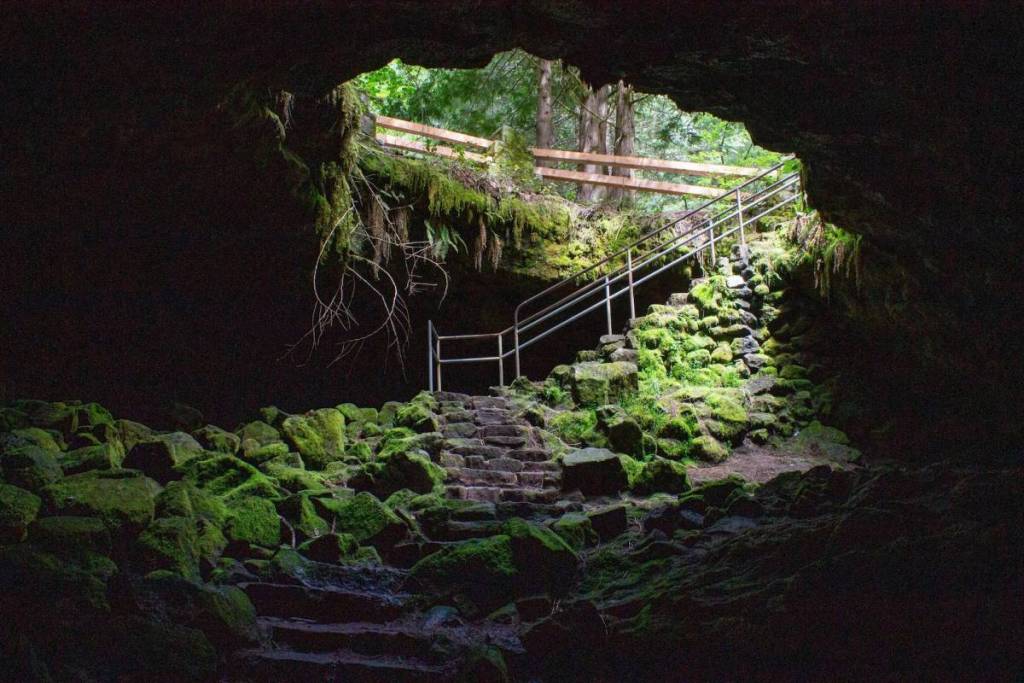

If you’re looking for a unique hiking adventure within driving distance of Seattle, one Washington destination is getting some major national attention.
The New York Times recently included Ape Cave, a remarkable lava tube in the Gifford Pinchot National Forest, on its list of “6 Natural Wonders You Won’t Find in a National Park.” The list focuses on “awe-inspiring sites” outside the country’s crowded national parks. Although these places may have fewer amenities and require visitors to be more self-reliant, they reward intrepid adventurers with less crowds and unique experiences.
For Seattle-area travelers, Ape Cave offers the chance to explore an unusual underground landscape formed by an eruption of Mount St. Helens roughly 2,000 years ago. It’s about a three-hour drive from Seattle, making it a possible destination for an ambitious day trip or a longer getaway.
Ape Cave was created when a lava flow from Mount St. Helens hardened on the surface while molten lava continued flowing through its center. When that lava eventually drained away, it left behind an enormous underground passage.
Today, visitors can put on a headlamp and venture into the 2.5-mile lava tube, where the temperature stays around a constant 42 degrees. That means even during warmer months, you’ll want to bring a jacket. Reliable lighting is especially important: visitors are advised to bring at least two sources of light per person. Cellphone lights aren’t considered suitable for this cave.
There are two hiking options inside the cave. The easier Lower Cave route is a 1.5-mile out-and-back journey through a relatively wide and flat section of the tunnel. For those looking for something more challenging, the more strenuous Upper Cave extends 1.5 miles into the lava tube before hikers make their way back aboveground on a route of the same length.
The Upper Cave is considerably more challenging. The route involves scrambling over dozens of boulders and climbing an eight-foot stone wall, so it’s best suited for visitors who are prepared for a more physically demanding adventure.
Ape Cave is open seasonally, from mid-May through the end of October. A two-hour timed reservation is required to visit, and visitors also need either a $5-per-day NW Forest Pass or an America the Beautiful Pass.
There are a few other rules and essentials to keep in mind. Dogs aren’t allowed inside Ape Cave, and food should not be brought into the cave. Remember to bring plenty of water, a warm jacket, and two reliable sources of light.
The New York Times’ larger point is that destinations like Ape Cave can offer something that’s increasingly difficult to find at America’s most popular parks: a chance to experience a spectacular natural wonder without the same crowds. The trade-off is that visitors need to arrive prepared and be willing to be self-reliant.
For Seattle readers willing to make the drive, Ape Cave offers a distinctly Washington adventure—one that takes you beneath the surface and into a landscape created by Mount St. Helens thousands of years ago.