
There’s a reason why you can probably name three Jeffrey Dahmer documentaries off the top of your head, and why one more episode always turns into four.
Researchers have actually mapped out why true crime hooks the brain the way it does — and the reason has less to do with morbidity and a lot more to do with how we’re wired to survive, judge, and connect.
It’s not just you
The pull you feel toward these stories isn’t a personal quirk — It’s a proven pattern researchers have identified.
Pew Research has tracked true crime as one of the most-streamed podcast genres in the country for years running. Reddit’s true-crime communities count their members in the hundreds of thousands. Entire college departments now study the genre as seriously as they study horror films or war reporting.
A modern phenomenon
Criminologists Kevin Haggerty and Ariane Ellerbrok, writing for the Centre for Crime and Justice Studies, make a case that’s easy to miss: serial murder as we understand it is a fairly recent invention. For most of human history, people simply weren’t exposed to enough strangers for it to exist on the scale we’re familiar with.
Big city life puts us shoulder-to-shoulder with people we’ll never actually know, which is exactly the kind of anonymity predatory strangers need. Mass media then transformed a handful of those predators into recognizable cultural figures. Celebrities built entirely out of fear.
In other words, the fascination isn’t random. It’s a consequence of the same conditions that built modern cities, news cycles, and fame itself.
The role of curiosity
Criminal justice experts tend to agree on why people gravitate toward this material. Dr. John Fisher (University of Texas Permian Basin) points out that we are almost universally raised to believe murder is unthinkable. So when someone does it anyway, again and again, the inevitable question is why. A natural human desire to learn what switch flipped and if it could flip on anyone.
Rasmussen University crafted a roundup of justice-studies experts that pointed to four overlapping reasons people get pulled into true crime:
A need to understand what drives “unthinkable” behavior in otherwise ordinary-looking people.
A desire to see justice being served, as true crime stories can scratch the same itch as a good puzzle — there’s a solvable mystery, and a “right side” we root for.
A controlled hit of fear, similar to why horror movies are enjoyable — the threat is real enough to feel but distant enough to walk away from.

Survival & Safety In Distance
Perhaps most consistently across the research, was a survival instinct. Listening to how a crime unfolded, in detail, can feel like absorbing a checklist of red flags to watch for later. A longing for safety and being in the know is a big driver to our curiosities about true crime, according to psychology and criminology expert Emily Mendez in a study for Rasmussen University by Jess Scherman.
Seeing what victims did or didn’t do, and having more knowledge about the crimes in question might make us feel in more control. Mendez goes on to explain this could be why consumers of true crime are largely made up of women.

Where true crime thrives
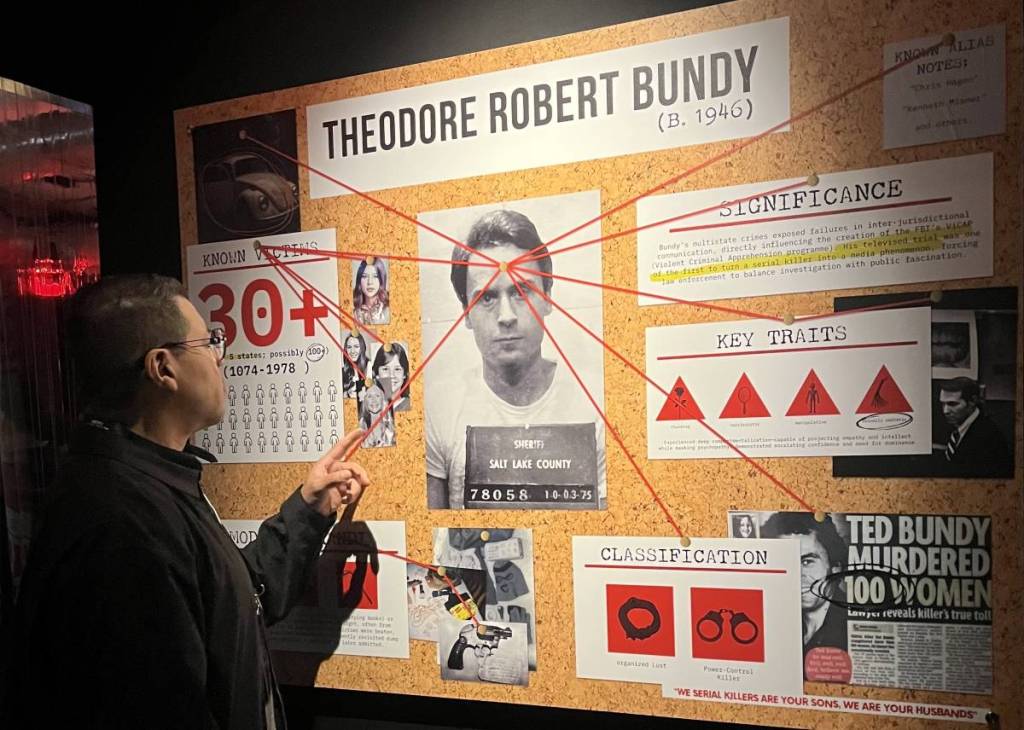
Podcasts undoubtedly remain the undisputed classic — but there’s a difference between hearing about criminal profiling and actually walking through the kind of investigative process Coduto’s research describes: case files, evidence boards, a reconstructed field office instead of a screen.
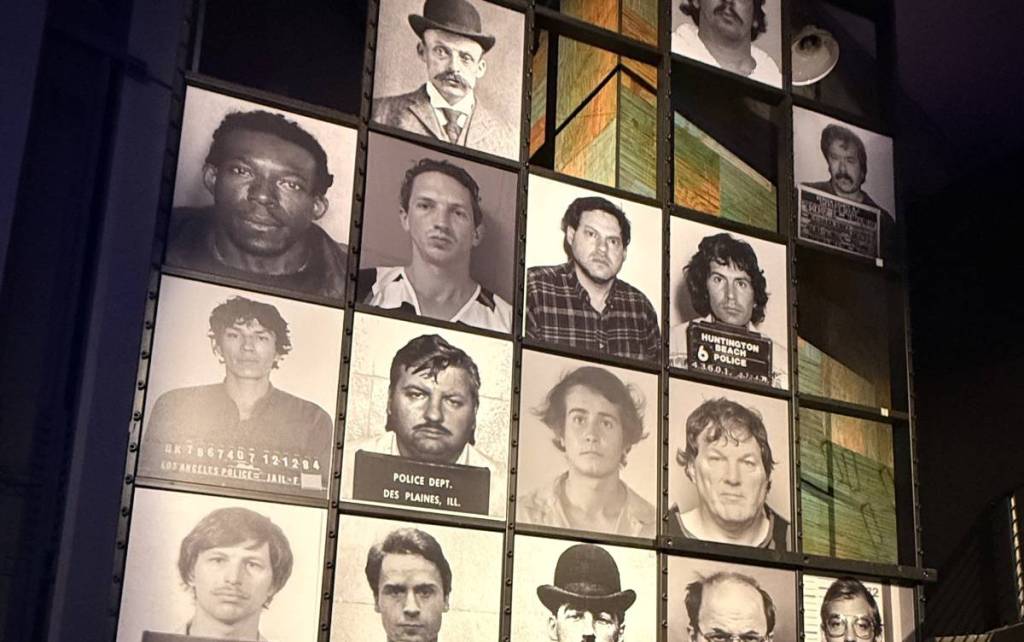
That’s effectively what’s happening right now in Manhattan. Mind of a Serial Killer: The Experience, running at 526 Sixth Avenue at the corner of West 14th Street, takes the same questions this research keeps circling back to — what drives someone to do this and how does an investigation actually unfold.
Guests can discover up-close the notorious cases that became cultural fixtures. From Ted Bundy to the Zodiac Killer, even featuring a VR segment where you’re handed the case file and have to work the investigation yourself.
True crime’s success has allowed it to evolve — giving us immersive exhibits like this one where we become more than just a passive listener.

The bigger picture
True crime isn’t something to feel guilty about. The research is pretty consistent on that point — our interest comes from curiosity, a desire for justice, and a very human need to feel prepared for danger rather than blindsided by it.
Getting emotionally tangled in a stranger’s tragedy because you can’t put it down is no accident, and the science is ready to prove it.
Liz Ramanand, contributed to this article.